Choosing China’s top Rechargeable Moped suppliers requires more than comparing prices and product photos. Global buyers must examine battery quality, motor performance, production consistency, certifications, and after-sales support. A showroom model may look impressive. Real performance appears on wet roads, steep streets, and during repeated daily charging.
Horace Luke, founder and CEO of Gogoro, has said, “The future of urban transportation is electric.” His view reflects a wider industry shift, but the transition is not effortless. Buyers still face uneven supplier communication, changing component quality, and unclear warranty terms. Some factories offer strong engineering. Others mainly compete through attractive quotations. This difference matters.
This guide introduces leading Chinese Rechargeable Moped suppliers for international buyers. It considers factory experience, battery management systems, frame durability, charging solutions, export capability, and service networks. It also highlights practical details, such as controller heat protection, spare-part availability, packaging strength, and delivery stability.
No supplier is perfect. That deserves attention.
A reliable evaluation should include factory audits, sample testing, production inspections, and document verification. Buyers should request measurable data, not broad promises. Battery cycle testing, water-resistance evidence, and braking performance deserve careful review. Local road rules and certification requirements must also be confirmed before purchase.
The strongest supplier is not always the cheapest. It is the partner that communicates clearly, documents its claims, and supports the vehicle after shipment. Some conclusions may change as technology and regulations develop. That uncertainty should encourage careful comparison, not rushed decisions.
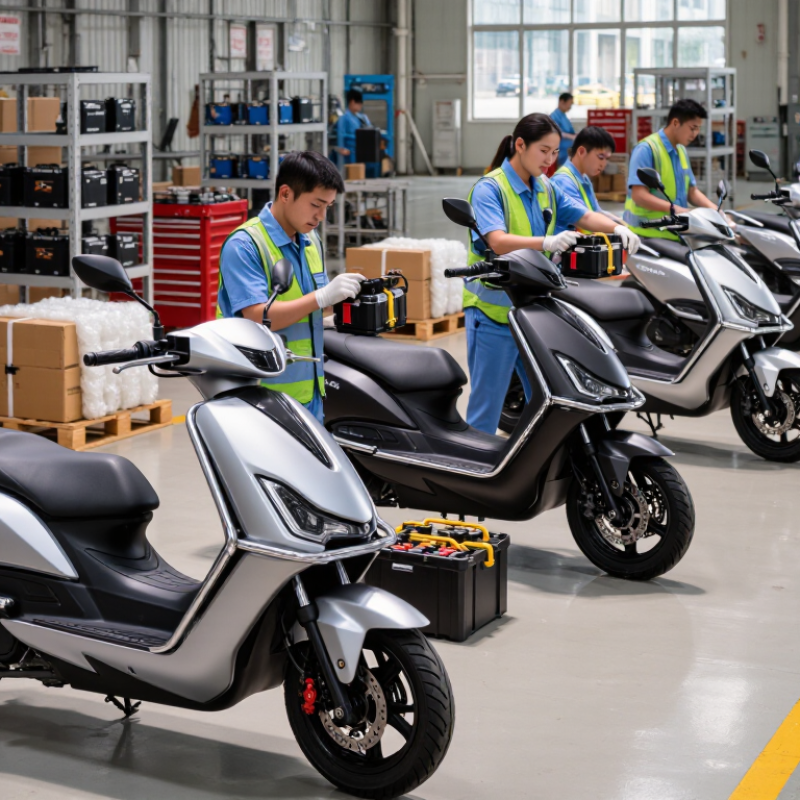
A leading Chinese rechargeable moped supplier is defined by engineering discipline, not a polished catalog. In supplier evaluations, buyers should inspect assembly lines, battery testing, and quality records. Look for traceable battery batches, consistent welding, and protected wiring beneath the deck. Good suppliers provide test data instead of vague performance claims. Details matter.
Technical expertise appears in motor matching, battery management, braking design, and frame durability. The supplier should explain charging limits, expected range, and performance under different loads.
Independent testing and market-specific certifications also support safer purchasing decisions. After-sales support is equally important. A practical spare-parts plan can reduce downtime for distributors and repair teams. This is where many offers look stronger than reality.
Reliability depends on transparent communication. Ask for clear warranty terms, production schedules, inspection procedures, and shipment documentation. Factory experience becomes visible when engineers answer technical questions without changing the subject. No supplier is flawless. Even experienced teams may face delays, component shortages, or inconsistent early samples. Credible suppliers acknowledge these risks and propose corrective actions. They admit limits. For global buyers, strong evidence, responsive service, and continuous quality improvement define a dependable rechargeable moped supplier.
China’s rechargeable moped production is concentrated in several practical manufacturing regions. Wuxi in Jiangsu is known for mature electric vehicle supply chains and large assembly capacity. Factories there often source motors, controllers, frames, and wiring from nearby specialists. This can shorten lead times and simplify quality coordination. However, high production volume does not always mean better customization.
Taizhou and Ningbo in Zhejiang offer strong metalworking and component networks. Buyers may find flexible frame designs, painted parts, and packaging services within one industrial area. Tianjin also remains an important northern hub, supported by experienced workshops and established transport links. Regional strengths differ. Some factories excel at volume, while others handle smaller trial orders more carefully. A factory visit should examine welding points, battery compartments, charger storage, and water-resistant cable routing.
Wuxi can be suitable for buyers seeking integrated supply chains. Zhejiang may work better for product variation and mechanical customization. Supplier evaluation still matters more than location alone. Request recent test reports, production photos, sample inspection records, and clear battery specifications. Verify capacity under realistic operating conditions, not only laboratory figures. Check whether quality inspections cover braking, lighting, tire installation, and charger safety. A polished showroom can hide weak process control. That risk deserves attention. Some purchasing teams also underestimate after-sales parts planning, especially for controllers, displays, and brake assemblies. An imperfect first sample is not automatically a failure, but unresolved defects should never be treated as normal.
China Top Rechargeable Moped Suppliers for Global Buyers
How to Evaluate Supplier Quality, Technology, and Certifications
Selecting a rechargeable moped supplier requires more than checking price and product photos. The IEA’s Global EV Outlook 2024 identifies electric two- and three-wheelers as the largest electric vehicle segment by global fleet size. This growth increases competition, but quality can vary sharply. Review factory inspection records, incoming battery checks, welding controls, and final road-test procedures. Ask for defect rates, warranty claims, and corrective-action records from the past twelve months. A polished certificate file can still hide weak assembly control.
Technology evaluation should focus on measurable performance. Request battery cycle-life results, thermal protection tests, charging efficiency, and range data under specific loads. Compare laboratory results with real-use conditions, such as hills, rain, cold mornings, and frequent stops. For lithium batteries, verify transport testing under UN 38.3 and product safety testing aligned with IEC 62133-2. Depending on the destination, check applicable vehicle rules, including relevant UNECE requirements. ISO 9001 can indicate process discipline, but it does not prove vehicle safety or battery durability.
Tips: Visit the production line, not only the showroom. Match certificate numbers with the exact model and battery pack. Ask for samples from normal production. Independent testing is worth the cost. Some evaluations remain imperfect; supplier documents may be incomplete, translated poorly, or outdated. Record every assumption before signing a purchase agreement.
China’s strongest rechargeable moped suppliers benefit from scale, battery access, and mature component networks. The International Energy Agency’s Global EV Outlook 2024 reports nearly 30% growth in global electric two- and three-wheeler sales during 2023. China remains the largest market and manufacturing base. The China Bicycle Association also reported electric bicycle production above 40 million units in 2023, showing significant industrial depth.
Market strength involves more than factory size. Experienced suppliers usually provide battery compatibility, motor testing records, spare-part systems, and export documentation. Buyers should inspect monthly capacity, quality-control checkpoints, and warranty response times. A factory visit can reveal practical details, such as packed containers, charging tests, and battery storage conditions. These details often matter more than polished catalogs.
The IEA notes that battery costs and charging infrastructure continue influencing electric mobility adoption. Therefore, suppliers offering replaceable battery options and clear safety testing deserve closer review. However, public production figures may combine bicycles, mopeds, and other vehicles. Comparisons can become imperfect. A low quotation may hide weaker cells, limited parts, or slow after-sales support. Buyers should request sample units, independent inspection, and shipment records before committing to volume orders. No ranking stays permanent.
Comparative market-strength index for the Chinese rechargeable moped supplier ecosystem. The score combines manufacturing scale, battery supply-chain access, export capability, OEM flexibility, product breadth, and after-sales readiness. No individual company or brand data is displayed.
Source basis: public industry evidence from the International Energy Agency Global EV Outlook, China’s electric two-wheeler manufacturing and export sector, and widely reported global electric mobility supply-chain trends. Scores are normalized to a 100-point benchmark for buyer comparison.
China Top Rechargeable Moped Suppliers for Global Buyers?
Ordering a rechargeable moped starts with a clear specification sheet. Include motor output, battery chemistry, range, charging time, payload, and road conditions. Ask suppliers for production photos, sample testing records, and current factory certificates. A video inspection can reveal wiring quality, welds, tire storage, and packaging methods. Do not rely on a polished catalog alone. Small details matter.
Compliance must be checked before payment. Moped classifications differ between countries and even between cities. Confirm speed limits, lighting, braking, identification plates, and charger requirements with local authorities. Request battery safety documents, transport test reports, and material declarations where applicable. Supplier documents may be incomplete or outdated. That creates risk. Have an independent inspection company verify key claims before mass production.
Shipping requires careful battery planning. Confirm whether batteries ship installed, separately packed, or under special freight procedures. Check carton dimensions, pallet strength, moisture protection, and unloading equipment at the destination. A low product price can become expensive after storage, customs delays, and damaged cartons. After-sales support should include spare batteries, controllers, displays, chargers, and repair instructions. Set warranty response times in writing, including parts coverage and labor responsibility. Remote training helps distributors solve basic faults, but it cannot replace local technicians. Test the support process before ordering hundreds of units. Some suppliers promise fast service, then reply slowly after delivery. That weakness deserves honest attention.
| Procurement Area | Data Dimension | Typical Market Benchmark | Key Buyer Requirements | Practical Planning Notes |
|---|---|---|---|---|
| Ordering | Pilot order quantity | Approximately 1–10 units for samples or field testing; approximately 20–100 units for a small commercial trial. | Confirm whether sample units use production-grade components and whether the sample price includes tooling, documentation, and delivery. | Pilot testing should cover range, hill climbing, braking, charging time, water resistance, packaging, and local road-use requirements. |
| Ordering | Standard production lead time | Commonly 30–60 calendar days after deposit, approved specifications, and component availability. | Obtain a written production schedule covering battery availability, final assembly, inspection, and export packing. | Custom colors, molds, dashboards, battery capacities, and software settings can extend lead time by approximately 15–45 days. |
| Vehicle Specification | Common battery configurations | 48 V systems with approximately 20–30 Ah are common; larger models may use 60 V systems with approximately 20–40 Ah. | Request the nominal voltage, rated capacity, usable energy, cell configuration, battery-management-system functions, and removable-battery test data. | Approximate nominal energy is calculated as voltage × ampere-hours. Actual range depends on load, speed, temperature, terrain, tires, and battery age. |
| Vehicle Specification | Typical charging performance | Approximately 4–8 hours with a standard charger for many removable lithium-battery configurations. | Verify charger input voltage, output current, connector type, over-voltage protection, short-circuit protection, and local plug compatibility. | Charging time varies with battery capacity, charger rating, battery temperature, and the battery-management-system charging limits. |
| Compliance | Lithium battery transport documentation | International shipments generally require applicable UN 38.3 test evidence, battery specifications, safety data, packaging information, and transport declarations. | Confirm whether the shipment is classified as UN 3480 or UN 3481 and whether the battery is shipped separately, packed with equipment, or installed in the vehicle. | Air transport can impose stricter requirements, including state-of-charge and packaging restrictions. Always verify the current carrier and destination-country rules. |
| Compliance | Vehicle-market approval | Requirements depend on whether the product is legally classified as an e-bike, moped, motorcycle, or another L-category vehicle. | Check applicable limits for maximum speed, continuous rated power, lighting, brakes, mirrors, tires, VIN, labels, noise, electromagnetic compatibility, and road registration. | For European markets, vehicle-category approval may involve Regulation (EU) No. 168/2013 and related technical requirements. Classification must be confirmed before purchase. |
| Quality Control | Pre-shipment inspection coverage | A practical inspection plan normally includes 100% power-on checks plus sampling or 100% checks for brakes, lights, charging, display, controls, and visible damage. | Use an agreed inspection checklist with acceptance criteria, photographs, serial-number records, battery voltage records, and carton measurements. | For larger orders, consider an independent inspection before final payment and retain production samples for future comparison. |
| Shipping | Ocean freight transit planning | Port-to-port transit from China to major European destinations often takes approximately 30–45 days; China to the U.S. West Coast often takes approximately 20–35 days. | Confirm the shipping term, export port, destination port, container type, dangerous-goods handling, insurance, and customs-document responsibilities. | Total door-to-door time is longer than ocean transit because it includes factory preparation, booking, port handling, customs clearance, and inland delivery. |
| Shipping | Packaging and container efficiency | Knock-down or semi-knock-down packaging can reduce cubic volume compared with fully assembled vehicles, subject to assembly capability and local regulations. | Request packed dimensions, gross weight, carton count, pallet requirements, stacking limits, moisture protection, and loading photographs. | Compare shipping cost by cubic meter and by vehicle, not only by product price. Battery segregation may affect container loading and documentation. |
| Customs | Import classification and landed cost | Duty, VAT or sales tax, port charges, inspection fees, inland transport, and recycling or environmental charges vary by destination. | Obtain the proposed HS code, commercial invoice, packing list, certificate of origin where applicable, bill of lading, and battery documents before shipment. | The importer remains responsible for confirming the correct tariff classification and all destination-country obligations with a customs broker. |
| After-Sales | Warranty period | Commercial offers commonly provide approximately 12–24 months for the vehicle or major electrical components, subject to exclusions. | Define separate warranty terms for the frame, motor, controller, charger, display, battery, tires, brake pads, and other wear parts. | Warranty terms should specify labor, freight, diagnosis, replacement criteria, water damage, misuse, normal capacity loss, and response times. |
| After-Sales | Spare-parts planning | A starting stock of approximately 1–3% of vehicle quantity for fast-moving service parts is commonly considered for initial market support. | Prioritize chargers, controllers, displays, brake components, throttle assemblies, cables, lights, tires, tubes, fuses, and common fasteners. | Stock levels should be adjusted using failure data, climate, road conditions, service capability, and the distance from the distribution warehouse. |
| After-Sales | Technical support response | A structured support process should acknowledge technical requests within 1–2 business days and provide a corrective action plan for confirmed faults. | Require wiring diagrams, service manuals, diagnostic procedures, spare-parts lists, fault codes, assembly instructions, and training materials. | Remote video diagnosis, replacement-part tracking, and serial-number records can reduce downtime for international distributors. |
| Risk Management | Payment and contract controls | International purchase contracts commonly define a deposit, a balance linked to inspection or shipping documents, and clear remedies for non-conformity. | Specify technical drawings, approved components, tolerance limits, inspection rights, late-delivery terms, intellectual-property ownership, and dispute resolution. | A staged payment structure and independently verified inspection reduce the risk of specification changes or unresolved quality defects. |
Inspect the assembly line, battery testing area, welding points, and wiring beneath the deck. Ask for traceable battery batches and recent quality records. A showroom can hide weak production control.
Request cycle-life results, thermal protection tests, charging efficiency, and range data under specific loads. Compare results on hills, cold mornings, rain, and frequent stops. Laboratory figures may not match daily riding.
Request warranty terms, inspection records, shipment documents, battery safety reports, and current factory certificates. Match certificate numbers with the exact model and battery pack. Old documents create avoidable risk.
No. ISO 9001 mainly indicates process discipline. It does not prove battery durability, braking performance, or complete vehicle safety. Independent testing remains valuable.
Include motor output, battery chemistry, range, charging time, payload, speed, and road conditions. Also record lighting, braking, charger, and identification requirements. Details prevent expensive misunderstandings.
Confirm local rules for speed limits, lighting, braking, identification plates, and chargers. Vehicle classifications may differ between countries or cities. Local authority guidance matters more than supplier assumptions.
Confirm whether batteries ship installed or separately packed. Check carton size, pallet strength, moisture protection, and unloading equipment. A low factory price can grow after storage and customs delays.
Support should cover spare batteries, controllers, displays, chargers, repair instructions, and response times. Set parts and labor responsibilities in writing. Test support before ordering hundreds of units. Slow replies reveal weakness.
China has become a major source of rechargeable two-wheel mobility solutions, supported by specialized manufacturing regions, mature supply chains, and flexible production capabilities. A leading Rechargeable Moped supplier should offer reliable battery systems, efficient motors, consistent assembly quality, product customization, and responsive communication. Global buyers should assess factory experience, quality-control procedures, testing standards, certifications, production capacity, and the supplier’s ability to provide clear technical documentation. Comparing suppliers by market strength also requires attention to export experience, model diversity, innovation, and long-term reliability rather than price alone.
Before placing an order, buyers should confirm specifications, minimum quantities, payment terms, packaging, shipping arrangements, import documentation, and compliance requirements in the destination market. Battery safety, labeling, warranty coverage, spare-parts availability, and after-sales support are equally important for reducing operational risks. A well-qualified Chinese supplier can provide dependable products and practical cooperation when it combines transparent business practices, verified manufacturing capability, effective quality management, and ongoing support throughout the purchasing and delivery process.
Lingmo
