China Top Electric Scooter Moped Suppliers for Global Buyers

Time:2026-10-21 Author:Sophia
0%

The global demand for practical urban transport is reshaping the electric mobility market. For importers, distributors, and fleet operators, choosing reliable China Top Electric Scooter Moped Suppliers requires more than comparing online prices. Product quality, battery safety, production capacity, and after-sales support can directly influence customer satisfaction and long-term costs.

This guide introduces key supplier considerations for global buyers seeking a dependable Scooter Electric Moped. It examines factory experience, motor performance, battery options, charging systems, frame construction, and customization services. A serious supplier should provide clear technical specifications, quality-control records, product testing information, and responsive communication. Buyers should also verify applicable certifications and transportation requirements for their target markets. Documentation matters.

Factory visits, sample orders, and independent inspections can reveal details that product photos often hide. Check weld finishing, brake response, tire quality, wiring protection, and packaging strength. Ask how warranty claims are handled and whether replacement parts remain available after purchase. These practical steps help reduce avoidable risks.

However, no supplier comparison is perfect. Market information changes, and impressive claims still require verification. Some factories may be strong in volume production but weaker in design support or overseas service. Others may offer attractive customization but lack consistent quality at scale. Careful buyers should compare evidence, not promises. With a balanced evaluation process, global businesses can identify capable Chinese partners and build safer, more stable electric mobility supply chains.
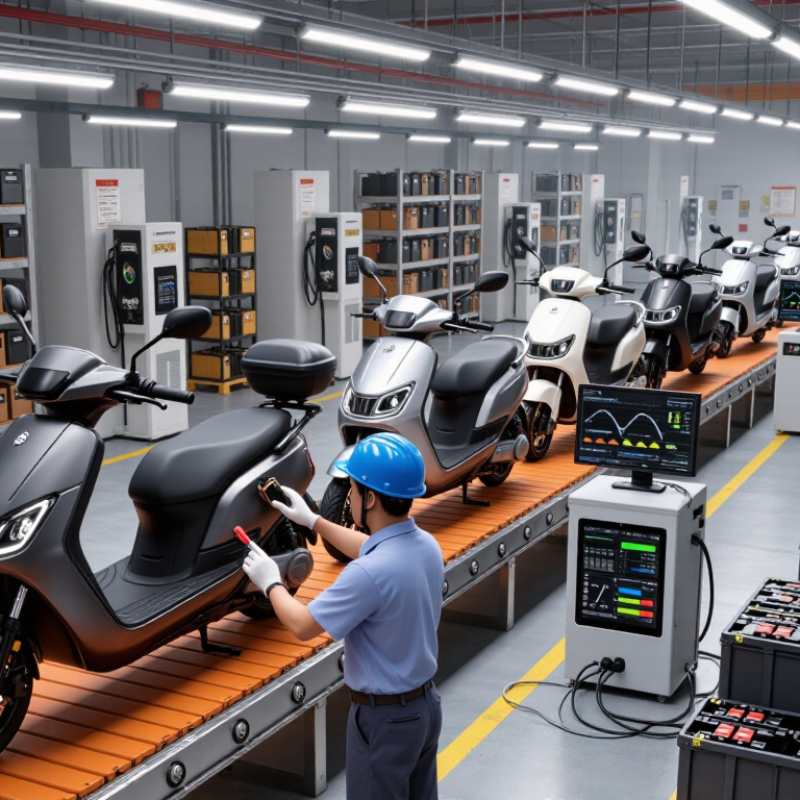
China Top Electric Scooter Moped Suppliers for Global Buyers

Electric Scooter Moped Manufacturing in China

China’s electric scooter moped manufacturing sector combines high-volume production with increasingly controlled quality systems. The IEA’s Global EV Outlook 2024 reports that electric two- and three-wheelers represent more than half of the world’s electric vehicle stock. China remains the largest production and sales hub. This scale supports competitive pricing, mature motor supply chains, and rapid component sourcing.

A capable factory should show more than a polished showroom. Inspect frame welding, battery-cell records, BMS calibration, motor testing, and waterproofing procedures. Ask for batch traceability and independent laboratory reports. UN 38.3 testing supports safer battery transport, while local certification remains essential for each destination market. Supplier audits also matter. A factory may pass one sample test yet struggle with long-term consistency. That gap deserves attention.

Tips: Request a pilot order before scaling. Check braking distance, hill performance, charging temperature, and real range under load. The China Bicycle Association has reported annual electric bicycle output exceeding 40 million units in recent years, showing strong manufacturing capacity. However, capacity does not equal reliability. Some factories still depend on manual inspection, and records can be incomplete. Buyers should compare production samples with shipment units, review corrective-action reports, and confirm spare-part availability. Clear specifications reduce disputes, especially for battery capacity, controller settings, frame dimensions, and charger compatibility.

Key Types of Chinese Electric Scooter Moped Suppliers

China’s electric scooter moped suppliers generally fall into four practical categories.

Factory-direct manufacturers build frames, motors, controllers, and battery systems in-house. They usually offer better customization and tighter production control.

OEM and ODM suppliers adapt existing platforms for overseas buyers. This reduces development time, but design changes may remain limited.

Trading and export companies coordinate several factories. They can simplify sourcing, although technical accountability becomes less clear.

Component-integrated suppliers focus on batteries, drive systems, or smart dashboards. They suit buyers with strong assembly and quality-control teams.

Supplier choice should match the buyer’s market and service capacity. The IEA’s Global EV Outlook 2024 identifies electric two- and three-wheelers as the world’s most widely electrified road vehicles. Its analysis also places China at the center of global electric two-wheeler production and use. A factory-direct partner may fit fleet orders requiring 60-kilometer daily routes, removable batteries, and reinforced rear racks. An ODM supplier may work better for retailers needing different colors, lights, and dashboard layouts. Ask for UN 38.3 transport test evidence, battery safety records, water-resistance ratings, and production inspection reports.

Look beyond the catalog.

The market research firm Mordor Intelligence projects continued growth in the electric scooter market through the decade, but forecasts differ by region and definition. That uncertainty matters.

A low quotation can conceal slower spare-parts supply or inconsistent controller batches.

Sample testing should include hill starts, repeated braking, overnight charging, and cold-weather range checks. Some suppliers communicate quickly before payment, then respond slowly after delivery. That is not always a failure, but it deserves a written service agreement.

How to Evaluate Suppliers for Global Purchasing

Evaluating China-based electric scooter moped suppliers requires more than comparing factory prices. A low quote may exclude battery testing, spare parts, packaging, or export service. Ask for the company’s registered details, factory address, production scope, and years serving overseas markets. Request recent audit records, not only attractive showroom photographs. Visit the facility when possible. Check whether frames, motors, controllers, and batteries follow a traceable inspection process. Small details matter.

Before placing a large order, buy a sample built to your target specification. Measure range, braking response, charging time, noise, and load performance under repeatable conditions. Ask for battery chemistry, cell documentation, protection features, and applicable test reports for your destination market. Confirm that labels, manuals, chargers, and packaging match the required language. A certificate without model-level relevance deserves questions. So does a report with an unclear issuer.

Commercial reliability also needs testing. Compare payment terms, minimum order quantities, lead times, warranty coverage, replacement-part prices, and response times. Put quality tolerances and inspection procedures into the contract. Clarify who pays for defective units and how claims are documented. Use pre-shipment inspection before releasing the balance. Communication is evidence: precise answers usually beat fast promises. Still, no evaluation is perfect. I would keep a risk reserve, because forecasts can fail when battery costs, shipping schedules, or local requirements change. Review performance after every shipment, and adjust the supplier score rather than trusting a first impression.

China Top Electric Scooter Moped Suppliers for Global Buyers - How to Evaluate Suppliers for Global Purchasing
Evaluation Dimension Key Data to Compare Recommended Reference Benchmark Documents or Evidence to Request Suggested Weight Scoring Guide
Product Classification Vehicle category, maximum design speed, motor rated power, battery voltage, and intended road use. Confirm that the configuration matches the destination market's legal definition for an electric bicycle, scooter, moped, or motorcycle. Technical specification sheet, vehicle drawings, motor label, battery label, and destination-market compliance statement. 8% 5 = Complete and market-specific; 3 = General specifications only; 1 = Classification is unclear.
Battery Safety Cell chemistry, nominal voltage, capacity in Wh, battery-management system, charger specification, and replaceability. Battery pack should have documented over-charge, over-discharge, over-current, short-circuit, and thermal protection. Lithium-ion cells should be supported by applicable transport and safety test records. Battery datasheet, BMS protection parameters, cell documentation, charger test report, and UN 38.3 test summary for lithium batteries intended for transport. 18% 5 = Full traceability and current test evidence; 3 = Partial evidence; 1 = No verifiable battery documentation.
Electrical and EMC Compliance Electrical safety, electromagnetic compatibility, controller protection, wiring quality, and charger conformity. Products should be tested against the electrical, EMC, and charger requirements applicable in the target market. IEC 62133-2 is a recognized reference for portable sealed secondary lithium cells and batteries. Accredited laboratory reports, declaration of conformity, circuit protection specifications, wiring diagrams, and charger test records. 15% 5 = Reports cover the exact model and configuration; 3 = Reports cover a similar model; 1 = Supplier provides only self-declarations.
Mechanical Quality Frame material, weld quality, braking system, suspension, wheel size, fasteners, and maximum load. Frame and braking specifications should be supported by documented load, durability, and functional testing. Braking performance must be assessed according to the regulations or standards of the destination market. Frame drawings, material certificates, weld inspection records, brake test reports, load test results, and critical-component inspection plans. 15% 5 = Independent or witnessed testing; 3 = Internal test records; 1 = No structured mechanical test evidence.
Weather and Environmental Protection Ingress protection of the battery enclosure, controller, display, connectors, and charging port. Use a clearly stated IP rating for relevant components. An IP rating is meaningful only when the test scope, product configuration, and report are identified; it does not automatically prove suitability for every weather condition. Ingress-protection test report, enclosure drawings, sealing materials, connector specifications, and water-exposure operating instructions. 8% 5 = Component-level evidence and clear limitations; 3 = Claimed rating without full report; 1 = No stated protection level.
Quality Management Production controls, incoming inspection, in-process inspection, final inspection, non-conformance handling, and traceability. A documented quality-management system, preferably certified to ISO 9001, with lot or serial-number traceability for frames, batteries, controllers, and chargers. Quality certificate, process flow chart, control plan, inspection checklist, corrective-action records, and sample serial-number traceability. 12% 5 = Auditable system and traceability; 3 = Basic inspection process; 1 = Inspection is informal or undocumented.
Production Capacity Monthly output, confirmed capacity during peak season, production lead time, and capacity reserved for the buyer. Capacity figures should distinguish theoretical capacity from confirmed monthly output and should be supported by recent production records. Capacity statement, production schedule, anonymized output records, factory audit report, and confirmed lead-time schedule. 8% 5 = Capacity is documented and consistent; 3 = Supplier gives estimates only; 1 = Capacity cannot be verified.
Customization Control Ability to modify battery capacity, controller settings, lighting, decals, packaging, accessories, and software configuration. Every engineering change should have a controlled specification, approval process, sample validation, and revision record before mass production. Engineering-change procedure, approved sample, bill of materials, product revision history, and pre-production approval form. 7% 5 = Formal change control; 3 = Customization available but loosely documented; 1 = Changes are handled verbally.
Quality Assurance Before Shipment Sampling method, 100% functional checks, battery inspection, road or roller testing, packaging inspection, and defect handling. Use a written inspection standard with measurable acceptance criteria. AQL sampling should specify lot size, inspection level, and acceptable and rejectable quality limits. Pre-shipment inspection checklist, AQL plan, functional-test records, defect photographs, corrective-action report, and inspection authorization. 10% 5 = Independent or buyer-authorized inspection; 3 = Supplier-only inspection; 1 = No formal pre-shipment inspection.
Export and Battery Logistics HS classification, lithium-battery shipping status, dangerous-goods handling, packaging, port options, and Incoterms® 2020 quotation. Quotation should clearly state trade terms, named place, included charges, battery transport requirements, and responsibility for export documentation. Commercial invoice sample, packing list, battery transport documents, packaging specification, freight quotation, and Incoterms® 2020 sales contract. 8% 5 = Complete and shipment-ready; 3 = Standard export experience; 1 = Responsibilities and charges are unclear.
After-Sales Support Warranty period, spare-parts availability, technical manuals, repair procedures, response time, and field-failure process. Warranty terms should define coverage, exclusions, claim evidence, replacement responsibility, and expected response time. Critical spare parts should have an identifiable part-number system. Warranty policy, spare-parts price list, repair manual, troubleshooting guide, service-level agreement, and warranty-claim workflow. 6% 5 = Structured global support; 3 = Basic warranty only; 1 = No defined service process.
Commercial Transparency MOQ, sample price, tooling cost, payment terms, price validity, packaging cost, spare-parts cost, and total landed-cost assumptions. Compare total landed cost rather than unit price alone, including product price, tooling, packaging, inland transport, freight, duties, taxes, inspection, and warranty reserves. Itemized quotation, pro forma invoice, payment schedule, tooling ownership clause, packaging specification, and landed-cost worksheet. 3% 5 = Fully itemized and consistent; 3 = Most costs disclosed; 1 = Hidden or frequently changing charges.
Scoring method: rate each dimension from 1 to 5, multiply the rating by the suggested weight, and compare suppliers only after confirming that the vehicle configuration and compliance documents apply to the exact model being purchased. Regulatory requirements vary by destination country and product category.

Export Standards, Certifications, and Market Compliance

China’s electric scooter moped suppliers serve a fast-growing global market. The IEA Global EV Outlook 2024 reports about 25 million electric two- and three-wheelers were sold worldwide in 2023. Export buyers should examine more than factory photos. They need test reports, traceable component records, and clear production controls.

For European sales, suppliers should understand Regulation (EU) No. 168/2013, including vehicle type approval, lighting, braking, and electromagnetic compatibility requirements. UN Regulation No. 136 addresses rechargeable electric powertrain safety, while UN Regulation No. 10 covers electromagnetic compatibility. Battery shipments also require UN 38.3 transport testing. These documents are not interchangeable. A battery test report does not prove complete vehicle compliance.

China-based production may follow relevant GB standards, but destination-market approval remains essential. The ISO 9001 framework can support consistent manufacturing, yet it does not replace legal certification. During supplier audits, buyers should inspect charger labels, battery cells, weld quality, insulation distance, and water-resistance seals.

One practical warning: a neat certificate folder can still hide a weak charger or an unverified battery change. I have seen compliance checks fail because the tested sample differed from the exported model. Serial-number control and pre-shipment sampling reduce that risk, although no process is perfect. The 2024 Global Market Insights electric scooter industry review also highlights battery safety and regulatory approval as major purchasing factors.

Ordering, Shipping, and After-Sales Support Considerations

China Top Electric Scooter Moped Suppliers for Global Buyers

Ordering from China requires more than comparing unit prices. Ask suppliers for clear specifications, production photos, test reports, and battery documentation. Confirm motor power, charging time, load capacity, packaging size, and spare-parts availability before paying a deposit. A written purchase agreement should state quality standards, inspection rights, delivery dates, and remedies for damaged goods. Small details matter. A low quotation may exclude protective packaging or export handling fees.

Shipping plans should match the destination country and port conditions. Confirm the trade term, carton markings, customs documents, and carrier requirements for lithium batteries. Request loading photos and tracking information before departure. For larger orders, an independent pre-shipment inspection can identify loose wiring, scratched panels, or missing accessories. It costs extra, but rework after arrival costs more. I would still leave some budget for surprises; even careful planning is imperfect.

Tips: Test one sample under real riding conditions before mass production. Agree on warranty length, response times, and replacement procedures in writing. Ask whether the supplier keeps controllers, chargers, tires, and brake parts available. A reliable support plan should include video troubleshooting, service manuals, and a named contact. Do not rely on promises made only in chat. Keep every approved drawing, invoice, inspection record, and shipping document in one shared file.

China Electric Scooter Moped Purchasing Timeline

Typical planning ranges for international buyers covering ordering, production, shipping, customs, and initial after-sales response.

Planning benchmarks are shown in calendar days. Actual timing varies by order volume, vehicle configuration, battery documentation, destination country, shipping route, customs clearance, and support arrangements.

FAQS

What information should buyers request from an overseas electric scooter supplier?

Request registered details, factory address, production scope, and overseas sales history. Showroom photos are not enough. Ask for recent audit records and traceable production documents.

Should buyers visit the supplier’s factory?

Visit when possible. Inspect frames, motors, controllers, batteries, welds, seals, and inspection records. Look for consistent processes, not polished displays. A clean showroom proves very little.

Why is a sample order important?

A sample reveals real performance before a large purchase. Test range, braking, charging time, noise, and load capacity. Use repeatable conditions. One short test can miss problems.

What battery documents should buyers examine?

Ask for battery chemistry, cell records, protection features, and relevant transport test reports. Confirm the tested battery matches the exported model. A certificate alone is insufficient.

How can buyers check market compliance?

Compare the vehicle with destination-market rules for braking, lighting, electrical safety, and electromagnetic compatibility. Check chargers, labels, manuals, and packaging languages. A battery report does not prove full-vehicle compliance.

What commercial terms deserve careful review?

Compare minimum order quantities, payment terms, production lead times, warranty coverage, and replacement-part prices. Record response times too. Fast promises may hide slow service.

How should quality responsibilities appear in the contract?

Specify quality tolerances, inspection procedures, defect evidence, and claim deadlines. Clarify who pays for defective units and replacement shipping. Use pre-shipment inspection before releasing the balance.

How can buyers reduce risks after shipment?

Keep a risk reserve for battery costs, shipping delays, and changing local requirements. Review performance after every shipment and update the supplier score. My judgment may be imperfect. Treat every delivery as new evidence.

Conclusion

China has become a major center for electric scooter moped manufacturing, offering global buyers a wide range of models, including compact urban scooters, utility-focused mopeds, foldable designs, and higher-capacity options for longer commutes. Suppliers differ in production scale, customization capability, quality-control systems, and experience with international orders. When evaluating a supplier, buyers should review factory qualifications, product specifications, battery and motor performance, testing procedures, production capacity, communication efficiency, and references from comparable markets.

Successful purchasing also requires careful attention to export standards, safety certifications, battery transport requirements, labeling, documentation, and the compliance rules of the destination country. Buyers should confirm technical files and certification validity before placing an order. Clear agreements on minimum quantities, samples, payment terms, packaging, inspection, shipping arrangements, spare parts, warranties, and after-sales support can reduce risks. A reliable Scooter Electric Moped supplier should provide consistent quality, transparent delivery schedules, responsive service, and practical solutions for maintenance and warranty claims.


Sophia

Sophia

Sophia is a dedicated marketing professional with an exceptional depth of knowledge about her company's products and services. With a keen understanding of market trends and customer needs, she crafts insightful blog posts that not only inform but also engage readers, enriching the company’s online......